

MILPITAS, Calif. — December 12, 2022 — The worldwide semiconductor industry is projected to invest more than $500 billion in 84 volume chipmaking facilities starting construction from 2021 to 2023, with segments including automotive and high-performance computing fueling the spending increases, SEMI announced today in its latest quarterly World Fab Forecast report. The projected growth in global factory count includes a record high 33 new semiconductor manufacturing facilities starting construction this year and 28 more in 2023.
 “The latest SEMI World Fab Forecast update reflects the increasing strategic importance of semiconductors to countries and a wide array of industries worldwide,” said Ajit Manocha, SEMI president and CEO. “The report underscores the significant impact of government incentives in expanding production capacity and strengthening supply chains. With the bullish long-term outlook for the industry, rising investments in semiconductor manufacturing are critical to laying the groundwork for secular growth driven by a diverse range of emerging applications.”
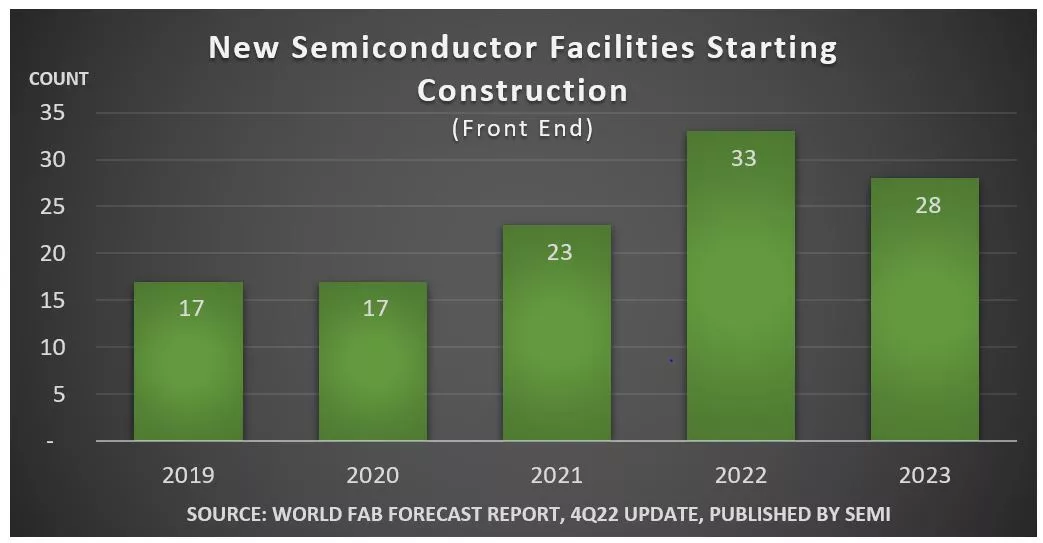
New Semiconductor Facilities Starting Construction by Region
The SEMI World Fab Forecast reports data from SEMI’s seven regions:
- In the Americas, the U.S. Chips and Science Act has vaulted the region into the lead worldwide in new capital spending as the government investment spawns new chipmaking facilities and supporting supplier ecosystems. From 2021 through next year, the Americas is forecast to start construction on 18 new facilities.
- China is expected to outnumber all other regions in new chip manufacturing facilities, with 20 supporting mature technologies planned.
- Propelled by the European Chips Act, Europe/Mideast investment in new semiconductor facilities is expected to reach a historic high for the region, with 17 new fabs starting construction between 2021 and 2023.
- Taiwan is expected to start construction on 14 new facilities, while Japan and Southeast Asia are each projected to begin building six new facilities over the forecast period. Korea is forecast to start construction on three large facilities.
The latest update of the SEMI World Fab Forecast report, published this month, lists more than 1,470 facilities and lines globally, including 162 volume facilities and lines with various probabilities that are expected to start production in 2022 or later. Download a report sample.
For more information or to subscribe to the World Fab Forecast and other SEMI market research report, please contact the SEMI Market Intelligence Team (MIT) at [email protected]. More information on the SEMI market data portfolio is also available online.
About SEMI
SEMI® connects more than 2,500 member companies and 1.3 million professionals worldwide to advance the technology and business of electronics design and manufacturing. SEMI members are responsible for the innovations in materials, design, equipment, software, devices, and services that enable smarter, faster, more powerful, and more affordable electronic products. Electronic System Design Alliance (ESD Alliance), FlexTech, the Fab Owners Alliance (FOA), the MEMS & Sensors Industry Group (MSIG) and SOI Consortium are SEMI Strategic Technology Communities. Visit semi.huihuidehui.workers.dev, contact one of our worldwide offices, and connect with SEMI on LinkedIn and Twitter to learn more.
Association Contact
Michael Hall/SEMI
Phone: 1.408.943.7988
Email: [email protected]
 “The new SEMI Semiconductor Cybersecurity Risk Rating Service will help Taiwan semiconductor companies bolster their cyber defenses as they deploy smart manufacturing practices that rely on greater connectivity both inside and outside of chip fabs,” said Terry Tsao, Global Chief Marketing Officer and President of SEMI Taiwan. “Crucially, the service will also facilitate cybersecurity decision-making as semiconductor companies work with their supply chain partners.”
 “Europe's future as a region of semiconductor manufacturing excellence is brimming with possibility,” said Laith Altimime, president of SEMI Europe. “The adoption of the European Council’s general approach marks a critical step in the passage of the European Chips Act, a landmark initiative for our industry.”
 “Semiconductor equipment revenue growth in the third quarter remained in line with positive forecasts for 2022,” said Ajit Manocha, SEMI president and CEO. “The 9% quarter-over-quarter increase in equipment spending for Q3 reflects the semiconductor industry’s determination to bolster fab capacity to support long-term growth and technology innovation.”
 The exhibition and conference will host Korea-based semiconductor powerhouses such as Samsung Electronics and SK hynix and other companies from across the supply chain as they showcase leading-edge semiconductor manufacturing technologies.
 The Board appointments took effect Oct. 18, 2022. Members serve a three-year term. The SEMI NAAB is the principal advocate for member companies located in North America. The Board provides guidance on SEMI Americas programs designed to advance the business interests of member companies and address significant challenges in the electronics manufacturing and design supply chain.
 “We look forward to perspectives from global thought leaders on semiconductor trends that are crucial to industry growth,” said Laith Altimime, president of SEMI Europe. “Companies from across the semiconductor supply chain will meet to explore new business and technology opportunities and ways to accelerate innovation.”
 ISS speakers will highlight regional and global investments that promise to drive the industry’s path to $1 trillion by 2023, with a focus on innovation and business opportunities in growth markets. Central themes at ISS 2023 will include semiconductor market drivers, private and public partnerships, technologies critical to extreme ultraviolet (EUV) innovation, supply chain resilience, environmental sustainability, and global cooperation across the supply chain.
 “We look forward to hosting industry leaders as they provide insights into microelectronics trends that are crucial to industry innovation and growth in Europe and around the world,” said Laith Altimime, President of SEMI Europe. “Key topics will take center stage as thought leaders address some of the world’s most pressing challenges.”













 Restricted travel and constraints on on-site access to experts across global semiconductor supply chains have accelerated the implementation of Smart Manufacturing strategies, big data analytics, autonomous systems and AI/ML technologies. Presentations at GSMC 2022, organized by the SEMI